Showing posts with label Unit I. Show all posts
Wednesday, January 15, 2014 - , , , , , 0 Talk Back(s)

Personality Continued: So Many Perspectives

Psychoanalytical Perspective:

  • Personality develops throughout life and is not fixed in childhood.
  • Freud under emphasized peer influence on the individual, which may be as powerful as parent influence.
  • Gender identity may develop before the age of 5-6.
  • Verbal slips can be explained on the basis of cognitive processing of verbal choices.
  • Suppressed sexuality leads to psychological disorders.
  • The psychoanalytical theory rests on the repression of painful experiences into the unconscious mind. 
Criticism: Scientific merits of Freud's theory has been criticized because it is lowly testable, and its concept arises out of clinical practice, which are after-the-fact explanation.
The Modern Unconscious Mind:
  • Shows evidence of nonconcious information processing
  • schemas: automatically control perceptions and interpretations
  • self concept and stereotypes unconsciously influence us 
Humanistic Perspective:
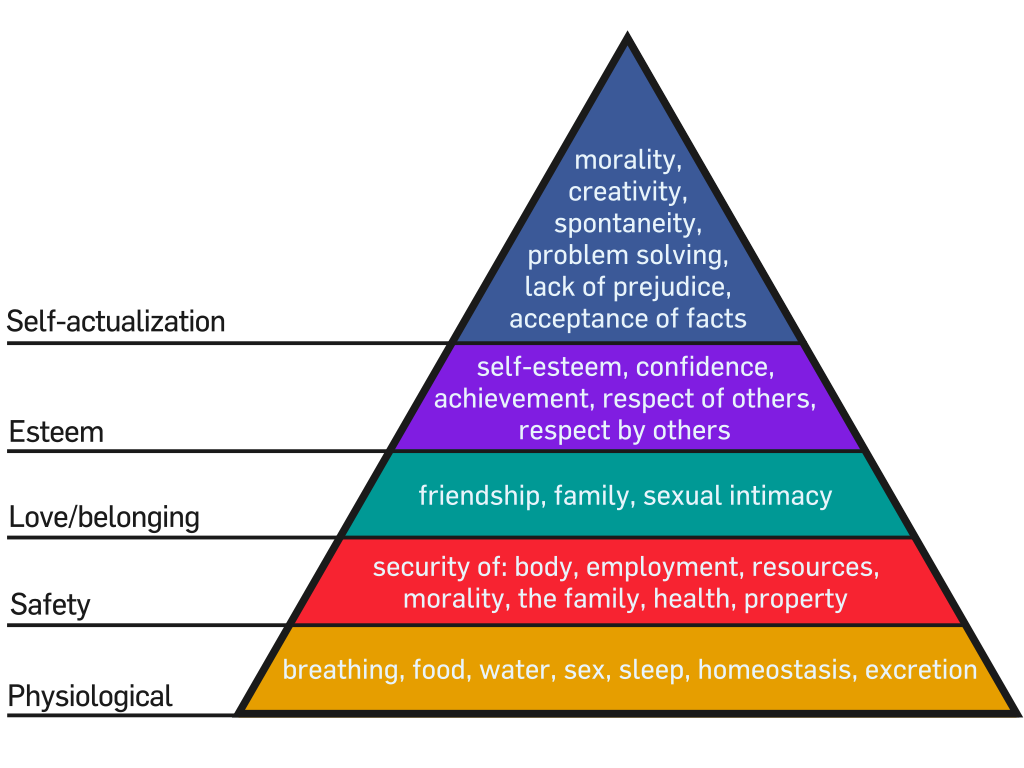
  • Maslow proposed that individuals are motivated by the hierarchy of needs.
  • We begin with the physiological needs and we try to fulfill out full potential (self actualization).
  • Carl Rogers believed in unconditional positive regard despite failing
  • Positive self-concept: If ideal and real are close.
  • Self-concept: Who am i?
  • Criticism: It is vague and subjective. It lacks scientific basis. The individualism encouraged can lead to self indulgence and lack of moral restraint. Humanistic perspective fails to appreciate reality.
Tuesday, January 14, 2014 - , , , , , , , 0 Talk Back(s)

Personality Continued: Neo-Freudians and Projective tests


The Neo-Freudians:

  • Unlike Freud, Adler believed that childhood tensions were social in nature.
  • Horney believe in the social aspect of childhood and countered Freud's assumption that women suffer from "penis envy."
  • Jung believed in collective unconscious (common reservoir among humans). 

Projective Test: Used to evaluate the unconscious mind.

  • Thematic Apperception Test: (TAT)- by Henry Murry, is a projective test in which people express their feelings by making up stories about ambiguous pictures.
                                          Watch the clip of a young boy being given a TAT test
Saturday, January 11, 2014 - , , , , 0 Talk Back(s)

Personality: Freud

Personality is an individual's characteristic pattern of thinking, feeling, and acting.
Freud
His clinical experience with patients led him to discover the first comprehensive theory of personality which included the unconscious mind, psychosexual stages, and defense mechanisms.  
  • The unconscious mind is filled with mostly unacceptable thoughts, wishes, feelings, and emotions
  • Can be retrieved through dream analysis or free association (saying whatever comes to mind)
Model of the Mind


Friday, January 10, 2014 - , 1 Talk Back(s)

Meet the Seven Perspectives

Modern Psychologists categorize their work by perspective in order to cover the different ways to view human behavior. They use these seven varieties of perceptive to study how we think, feel, and behave.


Connecting with the last chapter: 

1. Biological
  • Interaction between the brain/nervous system and behavior.
  • Key point: What affects your body affects your behavior.
2. Behavioral
  • Behavior is determined by your environment and experiences not genetics.
  • Key point: Everything is trained and learned. Nothing is born
  • Key People: Watson, Skinner, Pavlov
Wednesday, January 8, 2014 - , 0 Talk Back(s)

Understanding Psychology


Psychology is the study of behavior and mental process.
Behavior is anything we do that can be observed while the Mental Process is internal experiences such as thoughts and sensations.

Systematic Study is the systematic collection and examination of data to support or disprove an hypothesis rather than depending on the common sense.

Key Players in Psychology: